HOT (Human Origins Today) Topic: How Hair Reveals the Futility of Race CategoriesTina Lasisi is a biological anthropologist and Ph.D. Candidate at Penn State University. Her research helps us better understand human diversity and answer the question, "Why did modern variation in human scalp hair evolve?" How does a closer look at variation in scalp hair texture uncover the complexity of human diversity? Using computational image analysis, we can look at hair variation without invoking r...
The Nation's T. rex: From Montana to the Smithsonian(Get an audio described version of this video here: https://youtu.be/GxUkShe5oQk) Dr. Kirk Johnson, Sant Director of the National Museum of Natural History, introduces The Nation's T. rex and tells the story of how this fossil skeleton was discovered at the Fort Peck Reservoir. The fossil is on display at the museum in the David H. Koch Hall of Fossils – Deep Time. Where it was found: McCone County, Montana Learn more about this ob...
(AD) The Nation's T. rex: From Montana to the Smithsonian (Audio Described)This video has audio descriptions. (Watch a version with captions, but no audio descriptions, here: https://youtu.be/BIZQaqnOzN8 Dr. Kirk Johnson, Sant Director of the National Museum of Natural History, introduces The Nation's T. rex and tells the story of how this fossil skeleton was discovered at the Fort Peck Reservoir. The fossil is on display at the museum in the David H. Koch Hall of Fossils – Deep Time....
Oklahoma's State Crystal: Hourglass Selenite (Gypsum)Watch an audio described version of this video here: https://youtu.be/tyBIOK5JbRQ Angela Roberts, the audience studies manager at the museum, talks about an hourglass selenite specimen from her home state of Oklahoma. She describes how this variety of gypsum can only be found in one place in the world: the Great Salt Plains, or Cherokee Flats, of Oklahoma. This specimen is on display in the Janet Annenberg Hooker Hall of Geology, Gems...
(AD) Oklahoma's State Crystal: Hourglass Selenite (Gypsum) (Audio Described)This video has audio descriptions. (Watch a version with captions, but no audio descriptions, here: https://youtu.be/WVfqDSq5PmY) Angela Roberts, the audience studies manager at the museum, talks about an hourglass selenite specimen from her home state of Oklahoma. She describes how this variety of gypsum can only be found in one place in the world: the Great Salt Plains, or Cherokee Flats, of Oklahoma. This spe...
A Quill-y Mammal: North American Porcupine (Erethizon dorsatum) from WisconsinWatch an audio described version of this video here: https://youtu.be/-Xghb1ykvwA Carrie Beauchamp, a collections manager at the museum, introduces the North American porcupine on display from her home state of Wisconsin. She describes the behaviors of these prickly rodents and their special adaptations for cold weather and defense from predators. This specimen is on display in the Kenneth E. Behring Family Ha...
(AD) A Quill-y Mammal: North American Porcupine (Erethizon dorsatum) from WisconsinThis video has audio descriptions. (Watch a version with captions, but no audio descriptions, here: https://youtu.be/3zL-gXzw2wA) Carrie Beauchamp, a collections manager at the museum, introduces the North American porcupine on display from her home state of Wisconsin. She describes the behaviors of these prickly rodents and their special adaptations for cold weather and defense from predators. This speci...
A Strong Biter: Marsupial Mammal (Didelphodon vorax) Fossil from South Dakota(Watch an audio described version of this video here: https://youtu.be/iqtcijQlKsU) Fossil preparator Michelle Pinsdorf introduces this small marsupial, which was the largest mammal of its time 66 million years ago, but looks tiny next to Tyrannosaurus rex and Triceratops horridus in the David H. Koch Hall of Fossils – Deep Time exhibit. Didelphodon vorax is an ancient relative of the modern-day opossum. And ...
(AD) A Strong Biter: Marsupial Mammal (Didelphodon vorax) Fossil from South Dakota (Audio Described)This video has audio descriptions. (Watch a version with captions and no audio descriptions here: https://youtu.be/5NQWQSTY4_U) Fossil preparator Michelle Pinsdorf introduces this small marsupial, which was the largest mammal of its time 66 million years ago, but looks tiny next to Tyrannosaurus rex and Triceratops horridus in the David H. Koch Hall of Fossils – Deep Time exhibit. Didel...
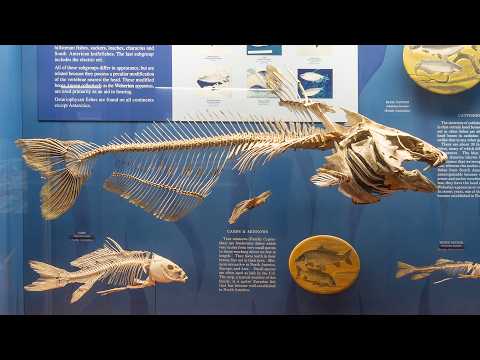
How the Blue Catfish (Ictalurus furcatus) Traveled From Missouri to the Smithsonian(Watch an audio described version of this video here: https://youtu.be/ErHBdendKd8) Senior Collections Manager Dr. Floyd Shockley, who grew up in Missouri, introduces the blue catfish specimen in the Bones Hall and tells the surprising story of how it got to the Smithsonian. This specimen was said to be 150 pounds at the time it was shipped from St. Louis to the Smithsonian in 1879. It is the type specime...
(AD) How the Blue Catfish Traveled From Missouri to the Smithsonian (Audio Described)This video has audio descriptions. (Watch a version with captions and no audio descriptions here: https://youtu.be/1IQSQskptlI) Senior Collections Manager Dr. Floyd Shockley, who grew up in Missouri, introduces the blue catfish specimen in the Bones Hall and tells the surprising story of how it got to the Smithsonian. This specimen was said to be 150 pounds at the time it was shipped from St. Louis to t...
New York's State Fossil: Eurypterid Arthropod (Eurypterus remipes), an Ancient Sea Scorpion(Watch an audio described version of this video here: https://youtu.be/YOOfUjy0pkk) Dr. Briana Pobiner, a paleoanthropologist at the museum who was born and grew up in New York, introduces this fossil "sea scorpion" that lived over 415 million years ago. Large eurypterids were one of the top ocean predators of their time. Eurypterus remipes fossils were first discovered in 1818 in New York. The fo...
(AD) New York's State Fossil: Eurypterid Arthropod (Eurypterus remipes), an Ancient Sea ScorpionThis video has audio descriptions. (Watch it with captions and no audio descriptions here, https://youtu.be/PzMjtWaeFZ0) Dr. Briana Pobiner, a paleoanthropologist at the museum who was born and grew up in New York, introduces this fossil "sea scorpion" that lived over 415 million years ago. Large eurypterids were one of the top ocean predators of their time. Eurypterus remipes fossils were fi...
Wyoming's Tiny Early Horse (Protorohippus venticolum)(Watch an audio described version of this video here: https://youtu.be/UC7xkixhIJw) Dr. Kirk Johnson, Sant Director of the National Museum of Natural History, introduces this fossil of an ancient horse, one of his favorite fossils in the David H. Koch Hall of Fossils – Deep Time exhibit. He describes how ancient horses from 52 million years ago were different from their modern relatives. For starters, this specimen is 20 inches tall...
(AD) Wyoming's Tiny Early Horse (Protorohippus venticolum) (Audio Described)This video has audio descriptions. (Watch a version with captions and no audio descriptions here: https://youtu.be/T66wQFW3fXA) Dr. Kirk Johnson, Sant Director of the National Museum of Natural History, introduces this fossil of an ancient horse, one of his favorite fossils in the David H. Koch Hall of Fossils – Deep Time exhibit. He describes how ancient horses from 52 million years ago were different from th...


 CRONOLOGICO
 AUTORI POST